Holiday home with sauna in the Eifel: your own outdoor sauna
 Familie Hahn
Your hosts at Waldsee Rieden
9 min read
Familie Hahn
Your hosts at Waldsee Rieden
9 min read
What “your own sauna" means in practice
“With sauna" appears in a great many listings. It can mean very different things: a shared sauna in the basement of a block of flats, a sauna cabin that you have to book by the hour, or an infrared cabin, which is not a sauna at all.
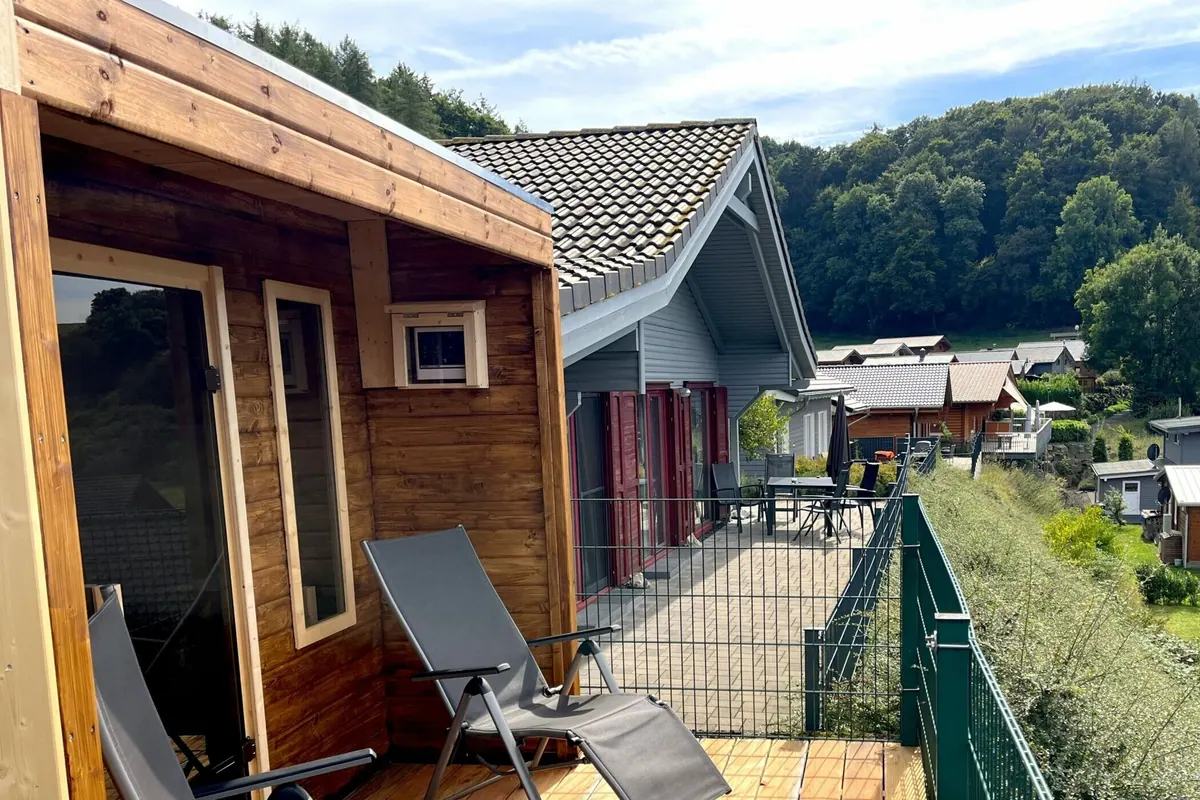
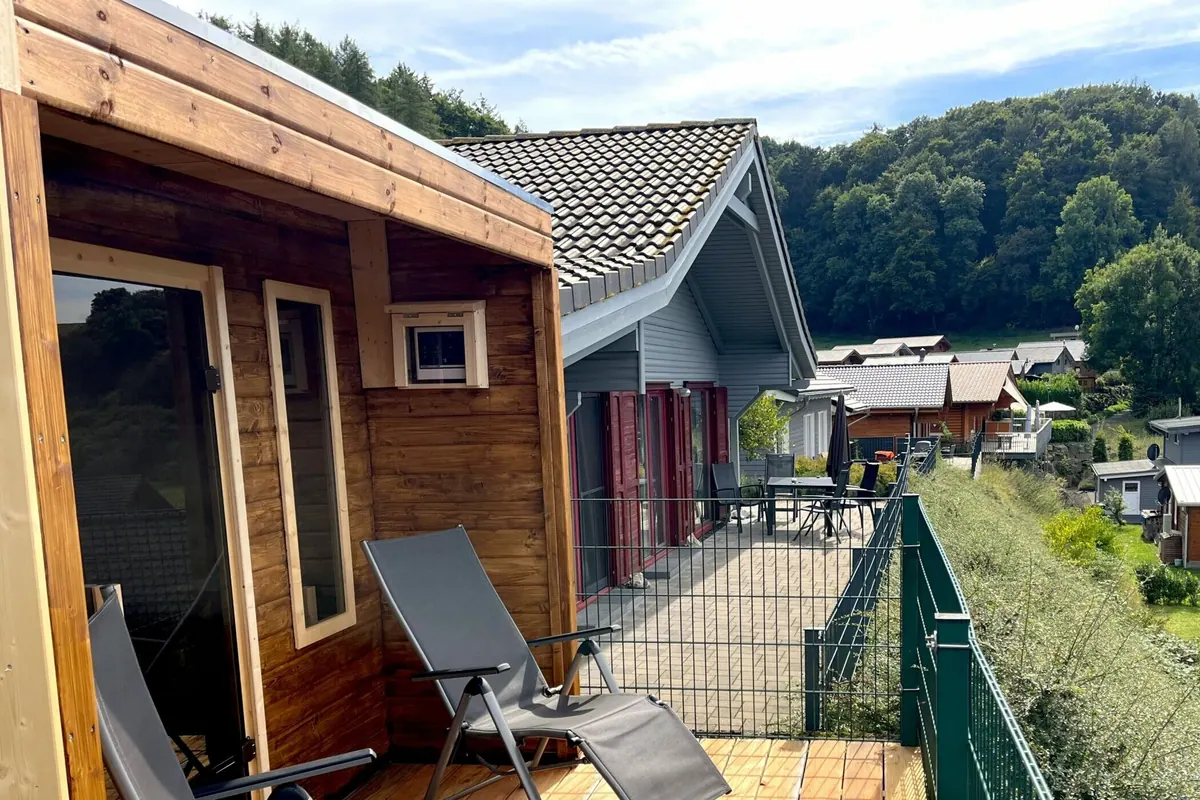
With us it is a private outdoor sauna on the terrace of every house. The difference shows in four things:
- No opening hours. You light it whenever you like, even at 22:00 after a long walk.
- No shared space. No strangers, no towels reserving benches, no debate about whether to wear swimwear.
- No booking slots. In a hotel spa the sauna is full at 16:00 on a rainy day. Not here.
- Outdoors, not indoors. The cooling-off step happens in the fresh air, not in a basement corridor.
What you do not get in return: scheduled sauna rituals with a sauna master, several cabins to choose from and a staffed relaxation room. If that is what you are after, thermal baths will suit you better; the nearest ones are listed further down.
Outdoor sauna: the difference is the cooling off
A sauna does not work through heat alone, but through the change between heat and cooling off. That is exactly what an outdoor sauna is built for.
The German Sauna Association (Deutscher Sauna-Bund), the industry body, recommends a clear order for cooling off: fresh air first, because the body needs oxygen and the airways want cooling, and only then water. On a terrace, that first step is two steps away.
In winter that is the real appeal. Stepping out of the cabin into a frosty Eifel night is something quite different from walking into a heated indoor room. Once you have done it, you understand why the sauna is an outdoor affair in Scandinavia.
One honest practical note: an outdoor sauna needs time to heat up. Depending on its size, its insulation and the temperature outside, that takes about half an hour to an hour, and rather longer in winter. If you want a sauna in the evening, switch it on after dinner, not when you are already standing there in your bathrobe.
The types of sauna at a glance
The terms get thrown around interchangeably. Here are the ranges as they are commonly used in the industry:
| Type | Temperature | Humidity | Principle |
|---|---|---|---|
| Finnish sauna | around 80 to 100 °C | low, around 10 to 20 % | dry hot air, infusions possible |
| Bio sauna, Sanarium | around 45 to 60 °C | around 40 to 55 % | milder, longer time inside |
| Steam room | around 40 to 50 °C | close to 100 % | steam instead of hot air |
| Infrared cabin | around 40 to 60 °C | no humidity produced | radiant heat, not a sauna |
Two things worth taking from that table. First: it is the humidity that decides how demanding it feels, not the number of degrees. A steam room at 45 degrees feels more intense than a bio sauna at 55 degrees, because sweat cannot evaporate.
Second: an infrared cabin is not a sauna. It warms the body by radiation rather than heating the air, so it never creates the heat-and-cold contrast that a sauna is all about. If you book a place “with sauna" and find an infrared cabin, you have been given something other than what you expected.
One caveat about the figures: there is no binding standard that defines what a “sauna" is. These values are industry convention, not regulation.
How to use a sauna properly
The only concrete expert guidance comes from the German Sauna Association, which is an industry body. Its “Ten Golden Rules" come down to this:
- Shower first and dry off thoroughly. Dry skin starts to sweat sooner.
- Eight to 15 minutes per session is plenty. How your body feels matters more than the clock.
- Sit up for the last two minutes, so that your circulation gets used to being upright.
- A towel under your whole body — sweat does not belong on the benches.
- Three sessions are considered ideal; according to this guidance, more brings nothing extra.
- Cool off in the air first, then with water. If you want to use a plunge pool, shower off before you get in.
- Bring time with you: allow at least two hours for a complete sauna routine.
There is one rule of the association’s that we deliberately do not pass on: the advice to drink nothing during your sauna session so as not to disturb the “detoxing". The “toxic waste" it refers to is not a medical concept, and going two hours without a drink while losing a great deal of fluid is poor advice, especially for older guests. Drink when you are thirsty.
What a sauna can and cannot do
A great deal gets promised here. So here is an honest assessment, sorted by how good the evidence is.
What can safely be said: a sauna is pleasant, relaxing and a good ritual after a long day outdoors. For many people it is the moment the holiday actually begins. That is a subjective statement, and it is quite enough.
What observational studies suggest: in Finnish long-term studies, frequent sauna use was associated with lower mortality and less high blood pressure. Those studies, however, largely involve Finnish men, they cannot prove cause and effect, and anyone who takes a sauna four times a week may well differ from other people in other ways too. “Saunas protect you from heart attacks" does not follow from this.
What is not proven, although you read it everywhere:
- Preventing colds. The independent evidence review by Cochrane Austria concludes that the scientific proof is missing. The one study that gets quoted again and again, from 1990, had 50 participants and no genuine randomisation.
- Detoxing and cleansing. The body detoxifies through the liver and the kidneys, not through the sweat glands. The “toxic waste" these claims refer to does not exist.
- Losing weight. The weight you lose in the sauna is water, and it is back as soon as you have had a drink.
- The evidence on skin, sleep and muscle recovery is thin as well.
We put this so plainly because a sauna is not a medicine. It is a lovely part of a holiday, and that is enough.
Who should not use a sauna
This is the most important section of the article.
Do not use the sauna if you have: an acute infection or fever, a recent heart attack, unstable angina, severe or decompensated heart failure, severe aortic stenosis or uncontrolled high blood pressure.
Talk to your doctor first if you have any diagnosed cardiovascular condition, high blood pressure or a heart rhythm disorder. For people with coronary heart disease, the German Heart Foundation gives a rough benchmark of managing at least 75 watts on an exercise ECG.
One more rule for anyone with a heart or circulatory condition: sudden cooling under a bucket shower or in a plunge pool is off limits, and so are infusions. Cool down slowly instead, in the air or with lukewarm water.
With an acute thrombosis a sauna is not suitable, because heat encourages clots to form. With simple, non-inflamed varicose veins, on the other hand, the specialist society for phlebology says there is nothing against it.
No alcohol before or during a sauna. Alcohol and heat both widen the blood vessels; together they can make your circulation collapse, and that is dangerous in a hot cabin.
During pregnancy there is no blanket ban, but no blanket all-clear either. If you already have sauna experience and an uncomplicated pregnancy, you can carry on after speaking to your doctor, with shorter sessions and lower temperatures. The first trimester is not the time to take it up for the first time. The advice on the whirlpool bath is more cautious than on the sauna, because in warm water the skin can no longer cool you and your body temperature rises faster.
Sauna with children
The recommendations clearly contradict each other here, and you should know that rather than have it smoothed over. The German Sauna Association gives a minimum age of three for public saunas, while paediatricians are often quoted as advising you to wait until around four.
What all the sources agree on:
- Shorter sessions: for children, more like 2 to 6 minutes rather than 8 to 15.
- The lower bench, where it is considerably cooler.
- No infusions with small children — the essential oils irritate the airways.
- Cool down gently, with no plunge pool and no ice-cold shower.
- One adult per small child, and within sight.
If in doubt, and before the first time: talk to your paediatrician. That is not a platitude; given how contradictory the recommendations are, it is the only sensible advice.
The whirlpool bath in the bathroom
Every house also has a whirlpool bath in the bathroom. Three practical notes:
- Warm water surrounds the body, so the skin can no longer cool you by evaporation. That is why your body temperature rises faster than in the sauna. The usual advice is around 15 minutes at a time; if you know you have circulation problems, keep it shorter.
- No alcohol in the whirlpool bath, for the same reasons as in the sauna, plus the risk of drowning.
- During pregnancy the whirlpool bath is the more critical of the two, see above.
If you do want thermal baths
Sometimes you want the full programme, with several cabins and a sauna master. Here are the options from Rieden, correct as of August 2026:
| Venue | Distance | Note |
|---|---|---|
| Nettebad Mayen | 13 km | the nearest sauna, day ticket around 17.50 € |
| Römer-Thermen Bad Breisig | 26 km | a chequered operating history, further refurbishment announced |
| monte mare Andernach | 27 km | large sauna complex, sauna and spa 27.50 to 45.50 € |
| Kristall Rheinpark-Therme Bad Hönningen | 31 km | several themed saunas and a hammam |
| Vulkaneifel-Therme Bad Bertrich | 58 km | thermal baths with sauna from 23 € |
| Emser Therme Bad Ems | 61 km | riverside sauna on the Lahn |
Two warnings that will save you a wasted journey:
- The Ahr-Thermen in Bad Neuenahr have been closed since the 2021 flood. No reopening date has been set. They still turn up in older lists of days out.
- Prices and opening hours at the thermal baths change often, and individual areas are sometimes closed for refurbishment. Have a quick look at the website before you set off.
Honestly: for most of our guests, the drive to the thermal baths is the worse deal. 27 kilometres there and back plus the entrance fee, against two steps onto your own terrace.
The best time of year for the sauna
October to March is the real sauna season. The colder it is outside, the greater the appeal of the contrast, and the more sense it makes to come in from a wet walk, into the heat first and then to the wood-burning stove.
In summer, in our experience, the sauna is barely used, while the whirlpool bath and the terrace are. If you book in July, treat the sauna as a bonus rather than the main reason for coming.
Autumn is the best combination of all: empty walking trails, woods turning colour, cool evenings and a sauna that is exactly right at that time of year.
FAQs
Does every house have its own sauna?
Yes. Each of the three houses has its own outdoor sauna on the terrace, plus a whirlpool bath in the bathroom. There is no shared sauna.
Do I have to book the sauna or pay extra for it?
No, it belongs to the house and you can use it whenever you like.
How long does it take to heat up?
Depending on the outside temperature, about half an hour to an hour, and longer in winter. Switch it on in good time.
How often and for how long should you use the sauna?
The expert recommendation is three sessions of 8 to 15 minutes each, with cooling off and rest breaks in between. Allow around two hours for the whole routine.
Is using a sauna good for your health?
Above all it is relaxing. Observational studies from Finland show links with lower mortality, but they cannot prove cause and effect. Common promises such as preventing colds or detoxing the body have no scientific evidence behind them.
Who should not use the sauna?
Anyone with an acute infection, a recent heart attack, unstable heart disease, severe heart failure or uncontrolled high blood pressure. If you have a cardiovascular condition, check with your doctor first.
Can children come into the sauna?
The recommendations vary; the ages usually given are three to four years. Either way: shorter sessions, cooler temperatures, the lower bench, no infusions and always supervised. Talk to your paediatrician before the first time.
Can you use the sauna during pregnancy?
With an uncomplicated pregnancy and previous sauna experience, usually yes after speaking to your doctor, with shorter sessions. Do not take it up for the first time in the first trimester. The advice on the whirlpool bath is more cautious.
Are there any thermal baths nearby?
The nearest public sauna is in Mayen, 13 kilometres away. There are larger sauna complexes in Andernach and Bad Hönningen. The Ahr-Thermen in Bad Neuenahr have been closed since 2021.
Our three homes
Susi for two to four guests, Annika and Tommy for up to six. Every house has its own outdoor sauna on the fenced terrace, a whirlpool bath in the bathroom, a wood-burning stove with firewood ready to use, free Wi-Fi and an EV charging point. From 150 euros per night.
The lake is around 150 metres away and the first Traumpfad begins about 100 metres from the front door. For a spa break that is about more than the house itself, that is the combination that counts: out during the day, sauna in the evening.
Your base for exploring
This destination is within easy reach of our holiday homes
Three holiday homes with their own outdoor sauna, whirlpool bath and wood-burning stove on the Sonnenterrasse by the Riedener Waldsee. This is where every day out in the Eifel begins.
Familie Hahn
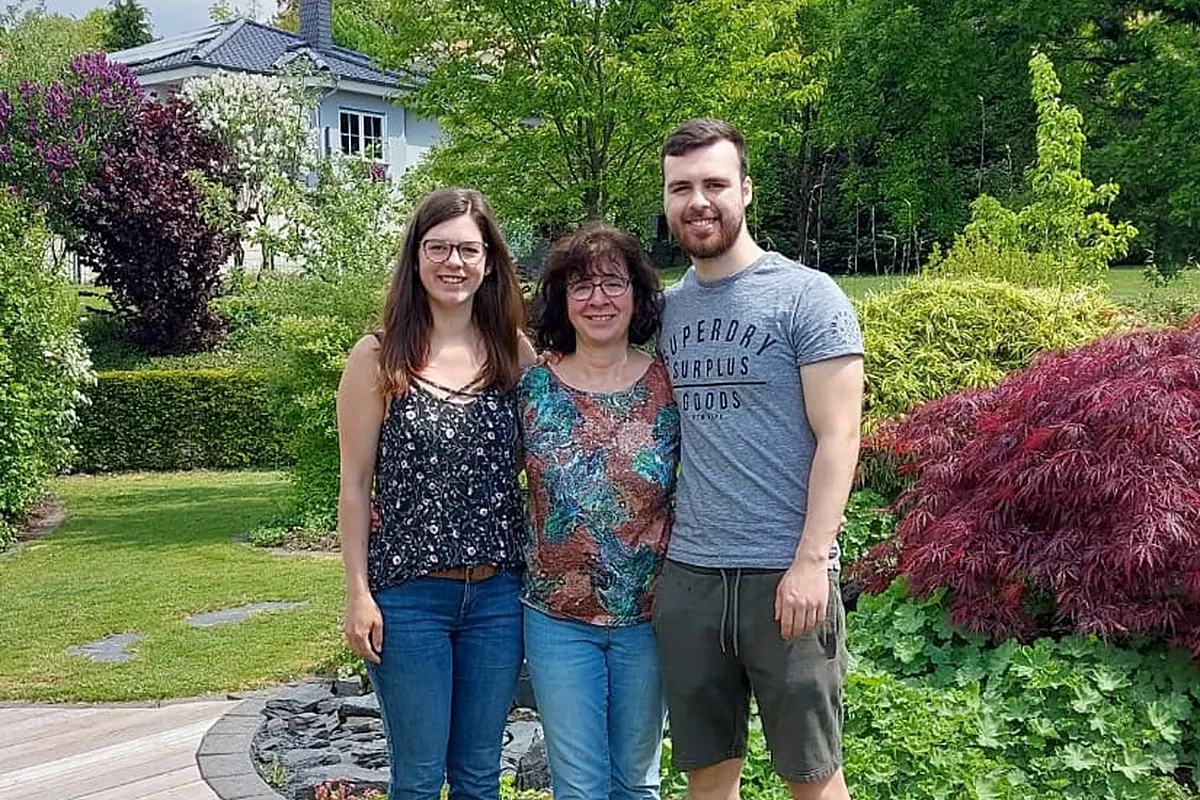
Susanne, Carmen and David Hahn rent out the three holiday homes on the Sonnenterrasse in Rieden and have known the Eifel for more than ten years.