Mayen slate mine: information and tips
 Familie Hahn
Your hosts at Waldsee Rieden
6 min read
Familie Hahn
Your hosts at Waldsee Rieden
6 min read
A modern, child-friendly museum for all the senses
Explorers young and old can learn a great deal about how slate was formed, mined and traded in the hands-on exhibition at the Deutsches Schieferbergwerk slate mine. A narrow passage leads you through the massive layers of rock inside the hill. Water drips from the cracks in the stone and sand crunches under your feet with every step. The only light in the underground galleries comes from coloured neon tubes.
Several well-signposted circuits lead you and your family through different themed areas, all of them about slate, formed millions of years ago from an ancient seabed. Thanks to the modern approach, what awaits you is not a dull exhibition but an experience that speaks to all the senses. Touching and trying things out is expressly encouraged. Even the youngest visitors take a lot away with them, feeling the fossils in the slate and exploring the many child-friendly exhibits. One highlight for children is certainly the old yellow walking excavator from Mensa Muck, which they may explore at length under supervision. In the section on slate mining, an experienced miner wakes from his sleep and tells you how laboriously slate was once won by hand and carried to the surface. For extra family fun there is a virtual animated ride in a mine wagon, on which you might just meet a dinosaur.
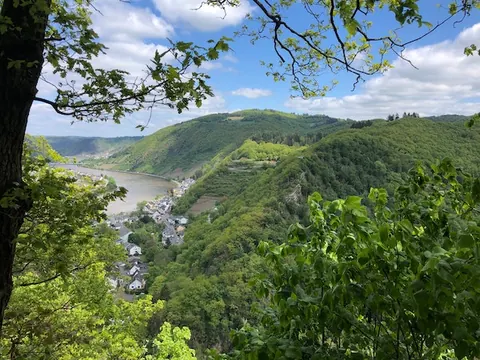
The Deutsches Schieferbergwerk in Mayen lies between the Rhine and the Moselle, in the middle of an appealing wooded landscape. This is where you find the romantic Eifel town of Mayen, home to the slate mine. That mining has gone on here for more than 2,000 years is plain from the many traditional dark blue slate roofs that still shape the townscape today. The town’s landmarks were of course roofed with Moselschiefer, the slate of the Moselle region: among them the medieval Brückentor gate, the dormer roof of the town hall built in 1717, and the artfully twisted spire that crowns the crooked church tower of St Clemens. According to an old legend, the devil himself is to blame for the leaning tower. If you would like to know more about the long history of Moselle slate, you should visit the fabled Genovevaburg. For beneath the castle, deep inside the dark hillside, lies the 340-metre labyrinth of galleries that makes up the Deutsches Schieferbergwerk slate mine in Mayen.
The remarkable past of the Deutsches Schieferbergwerk
Strictly speaking, the Deutsches Schieferbergwerk is not a real mine at all but a former air-raid shelter that saved the lives of around 4,000 people in the Second World War. After the gallery had stood unused for decades, someone hit on the idea in 1998 of setting up the Deutsches Schieferbergwerk down there. Since then visitors have been able to marvel at wire saws, mine wagons, imposing walking excavators and pneumatic drills weighing 20 kilograms in the underground passages beneath the 700-year-old Genovevaburg. The exhibition also takes up the story of the shelter during the devastating air raids of the Second World War. A crawlway 1.65 metres high leads into one of the shelter rooms, where the people of Mayen spent hours of fear during the war. Numerous shoes there recall those who owed their lives to the gallery. It was only thanks to that shelter that the civilian population survived the almost complete destruction of the town on 2 January 1945. You learn what families packed in their suitcases before fleeing into the bunker, and information boards let you read up on what happened in Mayen during the war.
The history of Moselle slate
Mining and trading slate has a long tradition in the Eifel. The Romans were already using weather-resistant slate to roof their houses. Excavations have turned up old Roman slate tiles, which are on display in the Deutsches Schieferbergwerk. Because heavy loads could once only be moved by river, the position of Mayen between the Rhine and the Moselle was ideal for exporting slate. Moselle slate soon became known far beyond the quarrying areas. By the Middle Ages a broad trading network for it had already grown up. Even Hildegard of Bingen mentions in her writings the dark blue “stone tiles from the Moselle with which houses are roofed”. To safeguard the quality of the slate that was won, the tiles were inspected by so-called “Decksteinbeseher”, or slate inspectors. One example of that thorough testing is the hammer test, which you can try for yourself in the exhibition. Only slate that gave off the right ring passed the dreaded hammer test. The Deutsches Schieferbergwerk offers plenty of further insights into the history of Moselle slate.
Moselle slate: an export success around the world
Slate is still mined in the region today, at depths of up to 270 metres. Thanks to modern machinery, though, the miners’ work is no longer as hard as it once was. And in place of the medieval slate inspector there are now generally accepted quality standards for slate. To this day, high-grade Moselle slate is used as an attractive design element in buildings all over the world.
Your visit to the Deutsches Schieferbergwerk slate mine
Like a miner, you travel the 16 metres down to the entrance of the gallery in a modern glass lift. At the bottom is the Kaue, as miners call their changing room. Here you will find jackets and helmets in various sizes to keep you safe in the show mine. The museum is largely accessible. As it stays fairly cool in the gallery even in summer, do bring warm clothing. Look forward to a very special experience underground with your family.
Opening times:
Admission prices:
Adults: 6.00 EUR. There are concessions for children and school pupils, for students and visitors with a disability (from a degree of 50%), for volunteers, for seniors (aged 60 and over) and for those doing voluntary military service or a voluntary social year, who pay only 3.50 EUR admission. Children under 100 centimetres tall go in free. If you would like to visit more than one museum, a combined ticket will save you money. Just ask the staff at the museum ticket desk.
More places to visit in the area
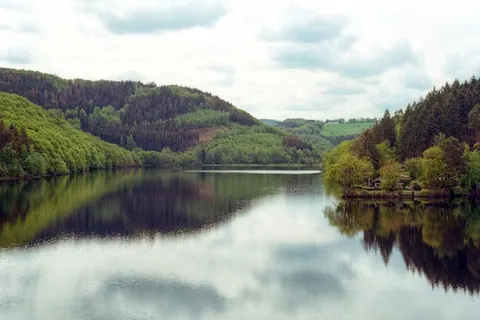
Just about 15 minutes’ drive from Mayen, the Laacher See lies in the middle of a nature reserve. It is the largest lake in Rhineland-Palatinate and is open to the public. A trip out there is well worth it for the quite extraordinary landscape that surrounds it.
The twelve water-filled maars of the Eifel are the hallmark of the Vulkaneifel. A maar is a crater lake: around 10,000 years ago volcanic activity blasted holes in the surface of the earth here, and water gathered in them over time. You can swim in the volcanic lakes “Pulvermaar” and “Gemündener Maar” not far from Mayen – a very special experience in the Vulkaneifel. The Ulmener Maar is geologically important: it counts as the youngest volcano in Germany and has been added by the IUGS (International Union of Geological Sciences) to the worldwide list of geologically significant sites.
Your stay in the Eifel
Enjoy the break you have earned in one of our special holiday homes, surrounded by glorious countryside right by the Waldsee Rieden. Our modern five-star timber chalets Susi, Annika and Tommy have room for the whole family, and your dogs are warmly welcome too. The setting is ideal, which makes our holiday homes the perfect base for trips out to volcanic craters, nature reserves, castles, maars and lakes. And when you do not fancy a day out and simply want to relax, take a seat on one of the comfortable loungers by the Waldsee Rieden. The sun warms your face and the water glitters in front of you – what more could you want? Enjoy the Eifel and the lake at the same time. Book your Eifel holiday now, quite simply, at urlaub-am-waldsee.de.
Yes, it stays fairly cool in the gallery even in summer. So please bring warm clothing.
Safety at the Deutsches Schieferbergwerk is of course checked regularly. For your own protection, though, you do have to put on a helmet and a protective jacket, both of which you are given at the museum.
Slate from Mayen is used mainly for roofing and for facades. More recently, Moselle slate has also been used for works of art
Your base for exploring
This destination is within easy reach of our holiday homes
Three holiday homes with their own outdoor sauna, whirlpool bath and wood-burning stove on the Sonnenterrasse by the Riedener Waldsee. This is where every day out in the Eifel begins.
Familie Hahn
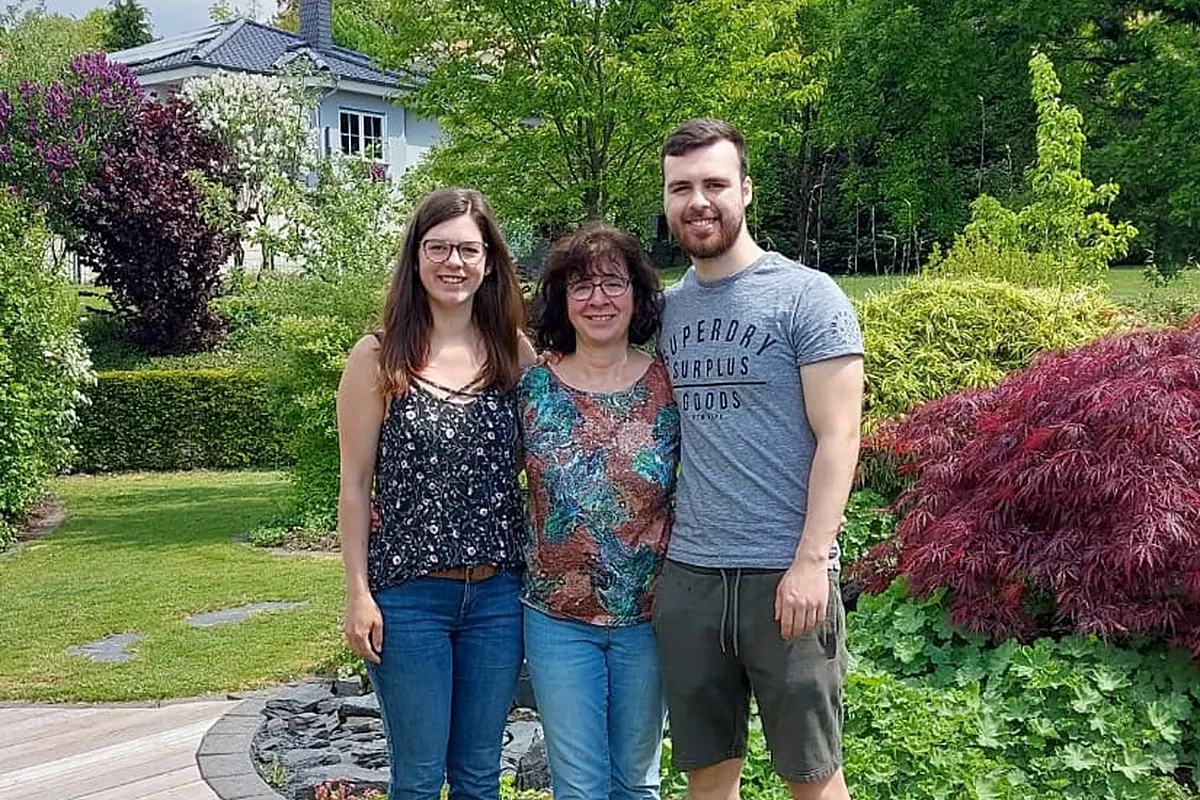
Susanne, Carmen and David Hahn rent out the three holiday homes on the Sonnenterrasse in Rieden and have known the Eifel for more than ten years.