Eifel National Park: nature at its purest
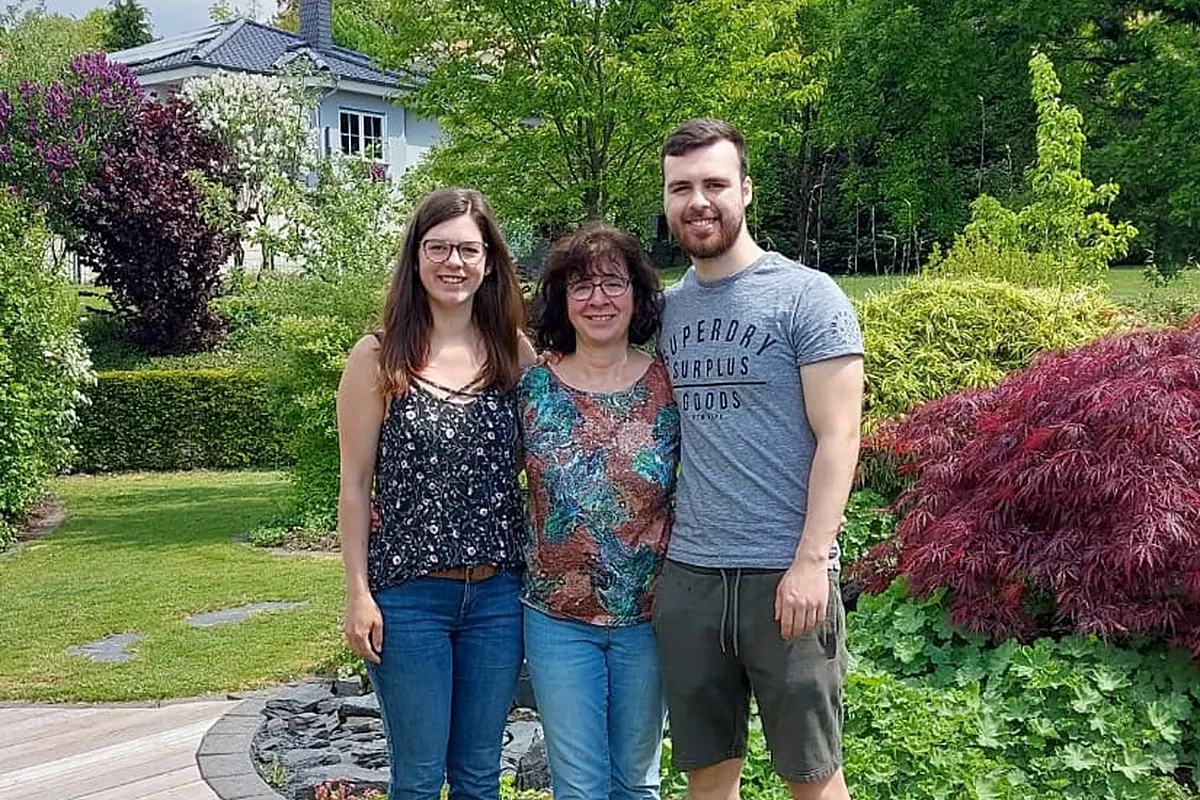 Familie Hahn
Your hosts at Waldsee Rieden
8 min read
Familie Hahn
Your hosts at Waldsee Rieden
8 min read
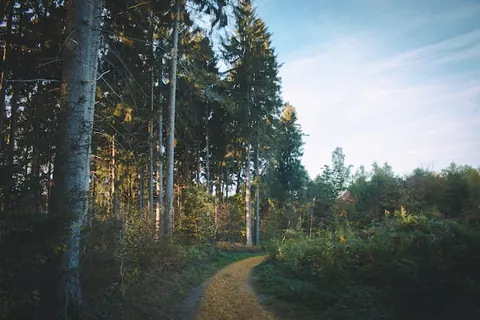
Holidays in the Eifel: volcanoes, crater lakes and nature all around
The Eifel is a region shaped by powerful natural forces. At the same time it is rich in cultural heritage and a paradise for walkers, cyclists and anyone who likes to keep active. Families with children and dogs get just as much out of it as guests looking for peace and quiet, older visitors and nature lovers. What follows is a taste of this wonderfully varied holiday region and of what makes it special.
The Eifel: the facts worth knowing
The Eifel is a cross-border upland range whose German part lies in Rhineland-Palatinate and North Rhine-Westphalia. Koblenz marks its eastern edge, Aachen its northern edge and Trier its southern one. To the west it merges into the Ardennes in Belgium and the Oesling in Luxembourg. The region is part of the Rhenish Massif, and some of its ridges rise to more than 700 metres. The highest point is the Hohe Acht at around 747 metres. Close behind comes the Ernstberg, also known as the Erresberg, at just under 700 metres. Both offer particularly good conditions for winter sports, but “good for skiing and sledging” applies to plenty of other hills in the region as well. Part of the northern Eifel has been a designated national park since 2004. The region also takes in the four nature parks of Südeifel, Vulkaneifel, Hohes Venn-Eifel and Rheinland. Large parts of the Vulkaneifel hold National Geopark and UNESCO Global Geopark status too. And not without reason, because this is where the Eifel’s characteristic maars and calderas are scattered across the landscape, giving it a charm all of its own. Maars are funnel- or bowl-shaped hollows of volcanic origin. They were created by steam explosions when hot magma met groundwater. In the Vulkaneifel alone there are more than 70 maars. A caldera, by contrast, is a basin-shaped structure that forms when a volcano collapses in on itself. The best-known caldera in the Eifel is the Laacher See. There is no large-scale industry in the Eifel. Farming, along with tobacco and hop growing, still plays a major role today. Quarrying stone and minerals such as pumice and basalt matters a great deal here as well. Thanks to the region’s volcanic past, mineral springs are unusually common.
The Eifel and its fascinating natural world
Fire, wind and water: these are the elements that have shaped the natural world of the Eifel. Over thousands of years a unique habitat has grown up here, home to more than 11,000 species of animals and plants. Over 2,500 of them are on the Red List, which means they are threatened with extinction. Travel with your eyes open and you will come across a diversity that is rare anywhere else. Among the rarest residents is undoubtedly the green hound’s tongue, a beautiful wild plant that is a little reminiscent of the forget-me-not. With its blue to violet flowers it is a real beauty. The violet copper butterfly has also become very rare in Germany, yet this colourful species is perfectly at home along the upland streams of the Eifel. The small Mediterranean water shrew likewise lives by unspoilt waters, and in marshy meadows as well. Only a few of them are left. Considerably larger is the red deer, the biggest animal in the region, impressive with its majestic antlers. Around 1,000 of them still live in the national park. On a stroll or a longer walk through the woods you may also come across the dark honey fungus. Did you know that this fungus officially counts as the largest living organism in the world at present? Its underground filaments spread across an area of several thousand square metres! The fruiting bodies above ground are most often found on spruce trunks. All the other animal and plant residents feel very much at home in the largely intact nature of the Eifel too. The European wildcat, for instance. Or the black stork, which unlike its white cousins is becoming ever rarer. Devil’s fingers, a fungus with extraordinary tentacle-like arms. The raccoon with its striking facial mask. And of course the proud beech: the thickest specimen in the national park has a trunk diameter of 100 centimetres!
Volcanoes and maars: the crater lakes that give the Eifel its face
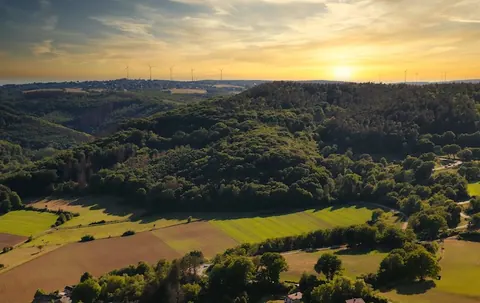
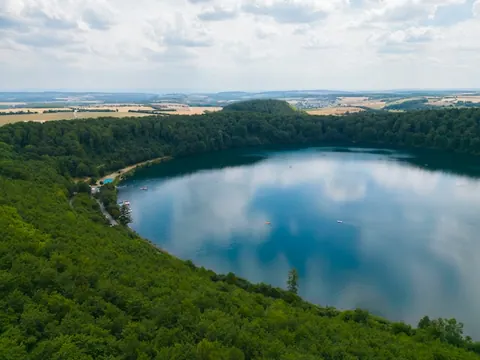
Volcanic activity in the Eifel is thought to have begun as long as 50 million years ago. The region still counts as volcanically active, at least in geological terms. But don’t worry: the last eruption in the Westeifel was 11,000 years ago, and in the Osteifel as long as 13,000 years ago. The maars still bear witness to that past. They are ancient, mostly crystal-clear and deep blue. Created by immense natural forces, today they are as peaceful as they are captivating. In some maars you can even bathe and swim. In the Vulkaneifel alone, twelve wonderful maars invite you to stop and stare, and they are perfect for exploring on foot. The three Dauner Maare, for example, lie side by side and were formed some 20,000 to 30,000 years ago. Or take the Weinfelder Maar, which has something very special in store for families with children and for every animal-loving walker: donkeys graze on its shores, and they are not at all averse to a bit of affection. Speaking of families, if you are out with a pushchair you will love the Jungferweiher above all. Today it is a well-known bird sanctuary where even the osprey has been spotted. The three-kilometre circular path around the maar is almost entirely level and easy to manage with a pushchair. An insider tip for those who like to take their time is the Meerfelder Maar. It is not yet all that well known and stays pleasantly quiet even in high season. The real highlight awaits you up on the crater rim, where the “Landesblick” viewing platform sits. The view of the maar and the surrounding countryside from up there is simply magnificent!
The finest sights and attractions in the Eifel
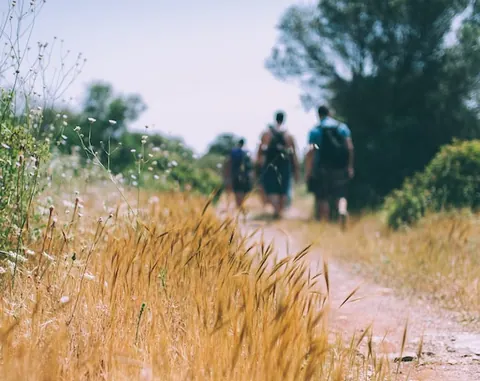
There is a great deal to discover in the Eifel. In the little town of Mayen, for example, the Genovevaburg is well worth a visit. It houses the Eifelmuseum together with the Deutsches Schiefermuseum slate museum. The system of tunnels beneath the castle is now a slate show mine that delights young and old alike. A visit to the Historische Wassermühle Birgel is another exciting journey into the past. Strictly speaking, this mill centre takes in several mills at once: a grain mill, a mustard mill and an oil mill. There is an old schnapps distillery to look round as well. At the Vulkanmuseum Daun you take a look inside our planet, and if you like you can even set off a volcanic eruption. At the Vulkanhaus Strohn, too, touching is expressly encouraged. If you have always wanted to know what real lava stone feels like, this is the place for you. Walkers are spoilt for choice on the 313-kilometre Eifelsteig long-distance trail, with 15 attractive stages to pick from. Each is between 15 and 28 kilometres long and guarantees new and indescribable impressions every time. If you are interested in culture and spirituality, Himmerod Abbey is a rewarding destination. Founded in the 12th century, the monastery is set in idyllic countryside and is today a place of quiet and confidence. In the picturesque village of Driesch stands the Mater Dolorosa pilgrimage church. The late Gothic building is known for its striking Baroque altar with its elaborate carvings. Games, fun, excitement and plenty of animal friends await at Daun Wildlife Park. After meeting the wild yaks and the birds of prey, how about a fast ride down the summer toboggan run? And a highlight not just for fathers and sons is the legendary Nürburgring. Seeing it “live” really is something special!
Towns and villages that are always worth a visit
Koblenz, with the Deutsches Eck, the Kaiser Wilhelm monument, Stolzenfels Castle and of course Ehrenbreitstein Fortress, is without doubt one of the main draws and simply ideal for a day out. The spa town of Gerolstein is lovely too. Its pretty streets and lanes are made for a stroll, and in the park you can even help yourself at a mineral water fountain and drink the famous “Gerolsteiner” for free. Mendig is known above all for its museums. This is where you find the Lava-Dome, the lava cellars and the Museumlay, which tells the story of basalt quarrying. If you still have time after your museum visit, do take a look at the centre of Mendig with its fascinating basalt architecture! Mendig is also home to the Vulkan Brauerei. The village of Kerpen will be familiar above all to fans of the well-known Eifel crime novels. There is even an Eifel crime-novel walking trail here! Quite apart from that, the medieval village centre is well worth seeing. For many people, Rieden with its Waldsee is the loveliest spot in the region. It lies right in the heart of the Eifel, a stone’s throw from the Rhine and the Moselle. A holiday at Waldsee Rieden is genuinely restorative, and its location makes the village an ideal base for wonderful days out. If you are looking for a holiday home by the lake, you are in luck. The private holiday park at Waldsee Rieden is laid out in beautiful terraces, surrounded by fairy-tale woodland and wonderfully quiet, yet still easy to reach. Every house is furnished individually and is thoroughly cosy. Interested in renting a holiday home, but would rather not cook on holiday and be looked after instead? There are plenty of good restaurants around the Waldsee, and your four-legged friend is warmly welcome in them too! Which holiday home in the Eifel you choose is of course up to you, but the five-star pick of the holiday park are the houses “Susi”, “Tommy” and “Annika”. These homes are certified by the DTV, the German Tourism Association, and leave nothing to be desired.
The Eifel lies between Aachen, Trier and Koblenz. In Germany it spans the two federal states of Rhineland-Palatinate and North Rhine-Westphalia.
Besides Eifel National Park, the trips most worth making are to Koblenz, Mendig and Mayen. Nature lovers should not miss the many maars, while motor racing fans will want to see the Nürburgring.
There are 75 maars in the region in all, some of them filled with water, some of them dry
Your base for exploring
This destination is within easy reach of our holiday homes
Three holiday homes with their own outdoor sauna, whirlpool bath and wood-burning stove on the Sonnenterrasse by the Riedener Waldsee. This is where every day out in the Eifel begins.
Familie Hahn
Susanne, Carmen and David Hahn rent out the three holiday homes on the Sonnenterrasse in Rieden and have known the Eifel for more than ten years.