Best time to visit the Eifel: a month-by-month guide
 Familie Hahn
Your hosts at Waldsee Rieden
12 min read
Familie Hahn
Your hosts at Waldsee Rieden
12 min read
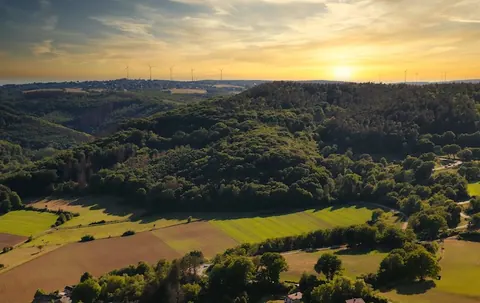
Why there is no such thing as “the Eifel climate"
The Riedener Waldsee and the Nürburgring are 30 kilometres apart, with around 250 metres of altitude between them. That sounds like nothing. In the climate data it is another country.
| Station | Altitude | Annual mean | Rainfall/year | Sunshine hours/year |
|---|---|---|---|---|
| Mayen (13 km from Rieden) | 230 m | 10,0 °C | 564 mm | 1.577 h |
| Nürburg-Barweiler (near the Nürburgring) | 485 m | 8,7 °C | 760 mm | 1.569 h |
| Nürburg (Hocheifel) | 627 m | 7,8 °C | 836 mm | 1.602 h |
Reference period 1991–2020 · Source: Deutscher Wetterdienst (German weather service), CDC climate data (long-term averages)
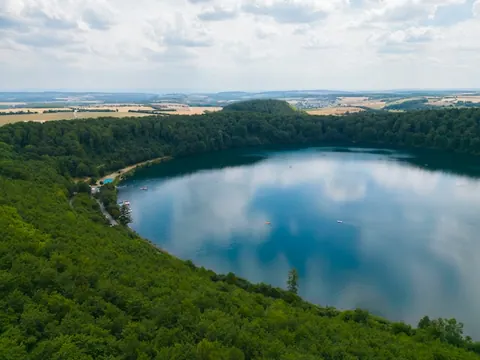
The centre of Rieden sits at around 380 metres, and the parish stretches from 337 m at the Riedener Mühlen up to 556 m at the Eselsmorgen. That puts the Waldsee between the two worlds: milder than the Hocheifel, cooler than the Rhine valley.
And now the sentence most Eifel articles never write: the Osteifel is not that wet at all. The 564 millimetres a year measured at the Mayen station compare with 792 millimetres for Germany as a whole (DWD national area average, 1991–2020). That makes the Osteifel one of the drier corners of the country. The reason is geography: the higher Eifel ridges to the west catch the moisture carried in by Atlantic low-pressure systems, and in their lee, in the Maifeld, in the Pellenz, in the area around Rieden, far less arrives.
With daylight the sums run the other way: 1,577 hours of sunshine in Mayen against 1,665 for the German average. So the Eifel is not especially wet, but it is a little greyer than the country as a whole.
That does not mean it rarely rains here. It means it often rains a little. At the upland station of Nürburg-Barweiler the long-term average shows at least one millimetre of rain on 122 days a year, every third day. If you book a week in the Eifel, reckon on two or three wet days and have a plan for them. That is exactly what our guide to rainy day attractions in the Eifel is for.
The climate table: month by month
| Month | Avg. temperature | Rainfall | Sunshine | What is on this month |
|---|---|---|---|---|
| January | 2,0 °C | 47 mm | 46 h | Quietest month, winter walking, many museums closed for the season |
| February | 2,7 °C | 36 mm | 71 h | Driest month, carnival, first clear long-distance views |
| March | 5,9 °C | 42 mm | 124 h | The trails dry out, wild garlic, wood anemones |
| April | 9,7 °C | 34 mm | 177 h | Second lowest rainfall, first leaves, the ideal walking months begin |
| May | 13,5 °C | 50 mm | 199 h | Broom in flower, long evenings, the Burgfestspiele Mayen season opens |
| June | 16,8 °C | 53 mm | 207 h | Bathing season opens on 1 June, Nürburgring season, longest days |
| July | 18,7 °C | 61 mm | 217 h | Warmest and sunniest month, and the wettest one too |
| August | 18,2 °C | 53 mm | 204 h | Peak season, warmest water in the lake, bathing season ends on 31 August |
| September | 14,2 °C | 47 mm | 151 h | Best walking weeks, mushroom season, first autumn colour from mid-month |
| October | 9,8 °C | 45 mm | 98 h | Autumn colour at its peak, Lukasmarkt fair in Mayen, height of the mushroom season |
| November | 5,7 °C | 45 mm | 48 h | Quietest weeks before the Christmas markets, mist and long views, first frosty nights |
| December | 2,9 °C | 52 mm | 36 h | Christmas markets, darkest month, weather for the wood-burning stove |
| Year | 10,0 °C | 564 mm | 1.577 h |
Climate averages 1991–2020, DWD station Mayen (230 m above sea level), rounded · Source: Deutscher Wetterdienst (German weather service)
Three things stand out in this table that you rarely read in a holiday brochure.
First: the wettest month is July. That is not a mistake, and in Germany’s uplands it is entirely normal. Summer rain comes as thundery showers, often heavy and over within two hours. November rain delivers fewer millimetres but feels far wetter, because it keeps going all day.
Second: April is the driest walking month. 34 millimetres and already 177 hours of sunshine, statistically the best combination of the whole year if what you want is dry ground and light and you can do without swimming weather.
Third: between October and November the sunshine halves. From 98 hours to 48. That is the real turning point in the Eifel year, not the start of winter on the calendar.
Spring: March to May, the underrated season
Spring is the season with the best value for money in the Osteifel. Temperatures climb from 5.9 °C in March to 13.5 °C in May, the sunshine hours rise from 124 to 199, and rainfall stays low.
March is a month in transition. The paths in the Riedener Wald are still soft and the trees still bare, but that means you can see through the leafless woods right up to the ridges, which is over once May comes. Frosty nights are normal well into April.
April is statistically the driest month of the entire walking season. If you want to do the walks that start right at the holiday park without wading through mud, and without sharing the trail with everyone else in August, this is when to come.
May is the month the region wakes up. The Burgfestspiele Mayen open their season and the places to visit open their doors again. The Waldsee is still far too cold for swimming at this point; it is a reservoir with no inflow from below and simply follows the weather of the preceding weeks.
The honest drawback of spring: the weather is changeable. A day in May can bring 25 °C or 8 °C, and both are possible within the same week.
Summer: June to August, the only time you can swim
Summer is the peak season, and for one very concrete reason: it is the only time you are allowed to swim in the Riedener Waldsee.
The bathing season is set officially at 1 June to 31 August, by water byelaw of the Mayen-Koblenz district authority dated 13.05.2026. That is not a recommendation but the period in which swimming is permitted and the water quality is monitored. What that means in practice, and how warm the water really gets, is covered in our article on swimming in the Riedener Waldsee.
In climate terms, summer here is moderate. A July average of 18.7 °C means pleasant, not hot. At the upland station of Nürburg-Barweiler there are on average 24 summer days above 25 °C and 4 hot days above 30 °C a year (1996–2025). Lower-lying Rieden has a few more, but the Eifel is not a place you flee to from the heat, it is a place where the heat leaves you in peace. The nights cool down reliably.
The price you pay: July and August are the weeks when the holiday homes are full, the car parks at Maria Laach are tight and the Traumpfade are busy. If you want quiet, you will find it in June: the bathing season is under way, the school holidays are not.
Autumn: September to November, the best time if you can do without swimming
If this article is to give one recommendation, it is this: September and October are the best weeks of the Eifel year.
September still averages 14.2 °C with 151 hours of sunshine, but the school holidays are over. The woods are damp after the summer rain and the mushroom season begins; what you may pick in the Osteifel and where the limits lie is set out in mushroom picking in the Eifel. From mid-month the leaves begin to turn.
October is the month you come to the Eifel for. The autumn colour peaks in the second week of October, high-pressure spells hold longer than in early summer, and the clear days that follow a misty morning give you long views you never get in the hazy summer. Autumn in the Eifel has an article of its own in the magazine, because it deserves one. On top of that comes the Lukasmarkt in Mayen from 10 to 18 October 2026, the region’s biggest funfair, 13 kilometres away, free to enter (as at August 2026, source: mayen.de).
November is the most honest month. 48 hours of sunshine, the darkest figure of the year after December; the leaves are on the ground and the mist sits in the valleys in the morning. Between the end of the autumn school holidays and the start of the Christmas markets lie two or three weeks in which quite simply nothing is on in the region. That is precisely the point. Book a holiday home with a sauna or a wood-burning stove and these weeks give you the best balance of price, quiet and comfort the year has to offer. November is not a week for walking, it is a week of retreat with some walks in it.
Winter: December to February, empty, cold and rarely white
This is where you have to be careful not to promise anything the weather cannot deliver.
Snow is not a reliable part of a winter holiday in the Osteifel. Here are the figures from the upland station of Nürburg-Barweiler (485 m), worked out from the DWD daily readings for the 30 years from 1996 to 2025:
- 32 days a year with at least 1 cm of snow cover, spread across January (10), February (9), December (6), March (4) and November (2)
- 17 days with at least 5 cm
- 9 days with at least 10 cm
- 1 to 2 days with at least 20 cm
- In 8 of the 30 winters from 1995/96 to 2024/25 there was not a single day with 10 cm of snow
And that is the station at 485 metres. Rieden lies around 100 metres lower, so less snow falls there and it lies for a shorter time. If you want to come to the Eifel to sledge or ski cross-country, your best chance is up on the heights of the Hocheifel around the Hohe Acht (747 m), but even there it is a matter of luck rather than something to plan around.
What winter does deliver reliably is emptiness. The walking trails are yours, and on clear winter days the long views are the best of the year. December adds the Christmas markets in Mayen, Kottenheim, Burgbrohl and Monschau; which one is on when is listed under Christmas markets in the Eifel.
The catch you need to know about: a lot is closed in January. The Lava-Dome Mendig takes its winter break from the beginning of December to the end of January, the Schieferbergwerk Mayen slate mine from 15 January to 15 February, and the Römerbergwerk Meurin from November to mid-March (all as at August 2026). If you come in January, plan for walking, thermal baths and quiet rather than for a museum programme.
The best time to visit, by type of holiday
| You want to … | Best time | Second best time | Why |
|---|---|---|---|
| Swim in the lake | July, August | June | Bathing season officially 1.6.–31.8.; warmest water usually late July to mid-August |
| Walk a lot | May, September | April, October | Mild temperatures, little rain, long days, and in April the driest paths |
| Quiet and space | November, January | February, March | Lowest occupancy of the year, trails and viewpoints free |
| With Children | July, August | Easter, autumn school holidays | Swimming plus a holiday programme; during the school holidays the Lava-Dome and the slate mine open on Mondays too |
| Autumn colour and mushrooms | October | Late September | Leaves turn from mid-September to late October, peaking in the second week of October |
| Photography | October, January | March | Misty mornings and long views in October, clear cold air in January |
| Christmas markets | Late November, December | — | Markets in Mayen, Kottenheim and Monschau from mid to late November |
| Spa, sauna and wood-burning stove | November to February | March | Lowest prices, shortest days, the best reason to stay indoors |
| Festivals and events | June to August | October | Burgfestspiele Mayen, Nürburgring season; in October the Lukasmarkt fair |
The case for the low season
Here is the sum most people never do: between early November and mid-December the region has everything it has in July, the woods, the volcanic landscape, the lake, the abbeys, the mines, only without the crowds and at different prices.
What is genuinely better in the low season:
- The trails are clear. On the Waldseepfad, the Traumpfade around Rieden and the shores of the Laacher See you will meet more buzzards than people in November.
- The viewpoints open up. With the leaves down, you can see further from the heights above Rieden than you can in summer.
- The indoor attractions are quiet. A tour of the lava cellars at the Lava-Dome in February is a very different experience from one in August, with three families in there at once.
- The thermal baths suddenly make sense. The Vulkaneifel-Therme in Bad Bertrich and the Römer-Thermen in Bad Breisig are open all year round.
- The price. Low season is low season.
What you accept in return: short days, less sunshine, outdoor attractions closed, and the likelihood of two wet days a week.
And when is the Waldsee at its best?
For the three holiday homes at the Riedener Waldsee there are really only two answers.
One is August: the lake is warm, the bathing season is under way, the children are in the water, and in the evening you sit outside until it goes dark.
The other is October: the woods around the lake turn colour, mist hangs over the water in the morning, mushrooms come up on the slope, and the lakeside path is yours alone.
Both answers are right. The second one simply costs less.
What the season changes for the three homes
The homes on the Sonnenterrasse suit both of this article’s answers. Each has a wood-burning stove with the firewood ready beside it, a whirlpool bath in the bathroom and its own outdoor sauna on the fenced terrace; bathrobes are in the house, but please bring your own sauna towels. In November and January, the emptiest weeks of the year, that is the difference between a short day and a long evening. In summer other things count: the hooded beach chair on the terrace and the 150 metres down to the water. How the three homes differ is set out under Holiday Homes.
In fairness: if you arrive in July, you will probably never fire up the sauna once. It is a bonus then, not a reason to book. The other way round, the Waldsee is still too cold for swimming in May, and outside 1 June to 31 August bathing is not permitted. The walk down to the shore is the same either way, it just does not end in the water. Dates that have come free at short notice are listed under Special Offers.
FAQs
When is the best time to visit the Eifel?
For walking and time outdoors: May, September and October. For a swimming holiday at the lake: July and August, because the bathing season at the Riedener Waldsee is officially limited to 1 June to 31 August. For quiet and low prices: November to February.
How much does it really rain in the Eifel?
At the German weather service (DWD) station in Mayen an average of 564 mm falls a year (1991–2020), well below the 792 mm national average for Germany. The Osteifel lies in the rain shadow of the higher Westeifel. In the Hocheifel near Nürburg, by contrast, the figure is 836 mm. What matters more than the amount is how often it rains: at the Nürburg-Barweiler station, 122 days a year bring at least one millimetre of rain.
Can you do winter sports in the Eifel?
Not reliably. At the upland station of Nürburg-Barweiler, at 485 metres, there is at least 10 cm of snow on only 9 days a year on average, and in 8 of the last 30 winters there was not a single such day. Rieden lies a further 100 metres lower. The Hocheifel around the Hohe Acht (747 m) has the better odds, but even there it is nothing you can plan around.
When is the Eifel at its quietest?
In the weeks between the end of the autumn school holidays and the start of the Christmas markets, so roughly from early to mid-November, and in January once the Christmas holidays are over. Hardly anything is on in the region during either period, so the walking trails and viewpoints are free. January adds the clearest long-distance views of the year.
When do the leaves turn in the Eifel?
The colour comes in from mid-September and lasts until the end of October. The peak usually falls in the second week of October, though it can shift by a week or two depending on the year.
How warm is the Riedener Waldsee in summer?
The lake is unheated and warms up purely with the weather of the preceding weeks. In June it is usually still fresh, July and August are the warmest phase, and in September it holds its warmth longer than the air does. No reliable series of water temperature readings is publicly available.
Your base for exploring
This destination is within easy reach of our holiday homes
Three holiday homes with their own outdoor sauna, whirlpool bath and wood-burning stove on the Sonnenterrasse by the Riedener Waldsee. This is where every day out in the Eifel begins.
Familie Hahn
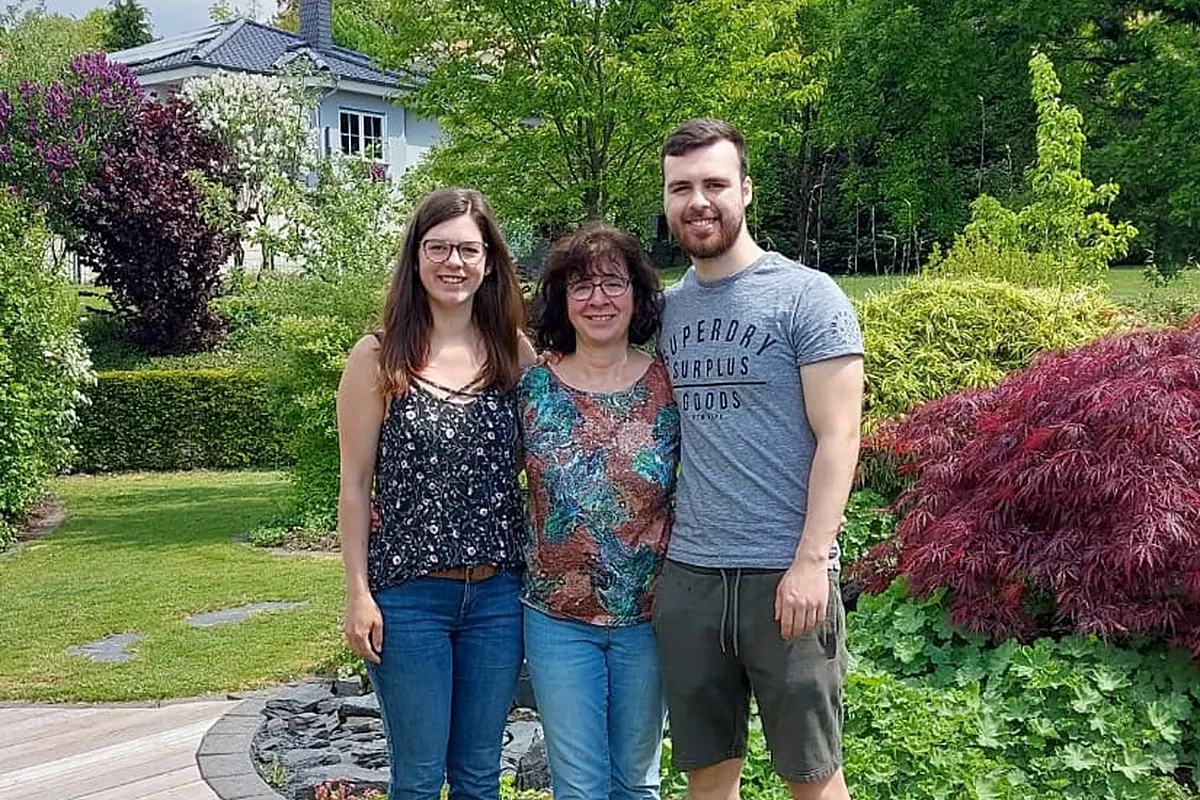
Susanne, Carmen and David Hahn rent out the three holiday homes on the Sonnenterrasse in Rieden and have known the Eifel for more than ten years.