Mushroom picking in the Eifel: rules, season, safety
 Familie Hahn
Your hosts at Waldsee Rieden
11 min read
Familie Hahn
Your hosts at Waldsee Rieden
11 min read
The law in Rhineland-Palatinate
The handful rule, and what it really means
Two sets of rules apply at once. At federal level, § 39 (3) of the Federal Nature Conservation Act allows anyone to take “wild flowers, grasses, ferns, mosses, lichens, fruits, mushrooms, tea and medicinal herbs and twigs" in small quantities for personal use and carefully, but only where there is no ban on access.
Rhineland-Palatinate sets this out in more detail in § 23 (1) of the State Forest Act (Landeswaldgesetz, LWaldG):
Commercial picking is permitted under § 23 (2) LWaldG only with the express permission of the forest owner. If you pick to sell, you also need a permit from the lower nature conservation authority; in the Mayen-Koblenz district that is the nature conservation department.
Important, and to be honest about it: Rhineland-Palatinate names no figure in kilograms. The much-quoted rule of thumb of “one kilo per person per day" is a guideline from conservation groups, not a legal limit set by the state. North Rhine-Westphalia does name two kilograms for its own forests, but that applies to the Nordeifel across the state border, not here. Landesforsten Rheinland-Pfalz, the state forestry service, deliberately keeps it qualitative: *“Only pick as many mushrooms as you can use up soon afterwards."* In practice that means a meal or two for the family, not a full rucksack. If you want to be certain, ask the forestry office responsible. *(As at August 2026, sources: gesetze-im-internet.de, landesrecht.rlp.de, wald.rlp.de)*
Protected species: the list that surprises people
Of all things, it is the most sought-after edible species that appear in Annex 1 to the Federal Species Protection Ordinance and are therefore *specially protected*: the cep (*Boletus edulis*), all chanterelles (*Cantharellus* spp.), all birch boletes and orange birch boletes (*Leccinum* spp.), all morels (*Morchella* spp.), the fishy milkcap and the pig’s ear.
For precisely these six groups, § 2 BArtSchV makes an exception: they may be taken “in small quantities for your own use". That is why cep and chanterelle may end up in the basket despite their protected status.
But: Annex 1 lists further fungi without that exception, among them Caesar’s mushroom, man on horseback, truffle, the waxcaps (*Hygrocybe* spp.), the March woodwax, the alder bolete and the sheep polypores (*Albatrellus* spp.). Those may not be picked at all. One trap is hidden in the names: the hedgehog mushroom (*Hydnum repandum*), Semmelstoppelpilz in German, is not protected and may come home with you; the similar-sounding Semmel-Porling (*Albatrellus*), the sheep polypore, is protected and may not.
Where you may not pick at all
This is the point that matters most directly to guests staying in Rieden.
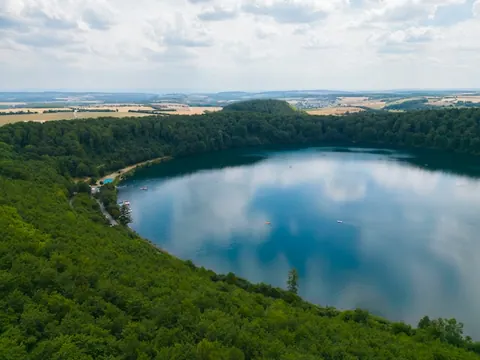
Picking mushrooms is banned in the Laacher See nature reserve. At around 21 square kilometres including the crater rim, it is the largest nature reserve in Rhineland-Palatinate (reference NSG-7131-006, first protected on 31 March 1940, the order recast in 1981 and extended in 1989). The order expressly forbids “damaging, pulling up or digging up plants, or picking, cutting or tearing off parts of them", mushrooms included. On top of that you must keep to the paths: leaving them is prohibited.
What matters is how far it stretches. The reserve covers not only the lake but the districts of Wassenach, Glees, Bell, Obermendig, Niedermendig, Kruft and Nickenich. Bell borders directly on Rieden. If you walk east from the holiday home into the woods, you can cross the boundary without noticing. There is more about the area itself in our article on the Laacher See and its circular walks.
Also off limits, quite apart from the reserve: fenced young plantations and thickets, closed sections of woodland, and areas where timber is being hauled out. And then the point nobody likes to read: the forest belongs to someone. Access on foot for recreation is free; driving in and parking on forest tracks is not.
What breaking the rules costs
The scale of fines in the Federal Nature Conservation Act is uncomfortably high: § 69 BNatSchG provides for fines of up to 50,000 euros for breaches of § 39 (1) and § 44 (1), and up to 10,000 euros for other breaches. That is the legal maximum, not the everyday case; nobody pays it for 300 grams too many in the basket. But turn up with crates, or get caught in the nature reserve, and you are in a different category. ## When each mushroom grows
The season in the Eifel begins in late summer and runs until the first hard frost. The clear peak is September and October.
| Mushroom | Main season | Where it grows | Protected? |
|---|---|---|---|
| Chanterelle | July – September | spruce and beech, mossy, nutrient-poor soils | yes, exception applies |
| Birch bolete | June – October | only under birches | yes, exception applies |
| Orange birch bolete | June – October | birch or aspen, young stands, woodland edges | yes, exception applies |
| Parasol | July – November | loamy soils, woodland edges, grassland | no |
| Cep | August – October | spruce in the uplands, oak and beech lower down | yes, exception applies |
| Cauliflower fungus | July – December, peak Sept./Oct. | at the foot of Scots pine trunks | no |
| Hedgehog mushroom | mid-July – early November | beech, fir and spruce woodland | no |
| Honey fungus | June – November | stumps and roots, broadleaf and conifer | no |
| Bay bolete | September – November | older spruce stands, acid soils | no |
| Horn of plenty | mid-August – late November | mainly under beech | no |
| Wood blewit | September – December | leaf litter, often only after the first cold snap | no |
*Poisonous raw and therefore always to be cooked right through: honey fungus, the blusher, wood blewit, orange birch bolete and birch bolete. NABU, the German conservation association, recommends 15 to 20 minutes of cooking for all woodland mushrooms.*
The weather factor
No rain, no mushroom year: that is the one hard rule. The Swiss Federal Institute for Forest, Snow and Landscape Research (WSL) has studied the connections over decades. Rainfall is what allows fruiting bodies to form, while temperature sets the timing. If August is warm, the season starts later. If it is cool, the mushrooms come earlier. In genuinely dry years there is barely a season at all.
Among pickers there is a rule of thumb that one to two weeks after a good soaking is the best time. There is no solid scientific evidence for that figure, and accounts from practice vary between three days and two weeks. It still works as a guide: after a wet week the walk is worth it, after four dry weeks it is not.
Another finding from the same research is reassuring: a 30-year experiment in the La Chanéaz mushroom reserve showed that picking the fruiting bodies does no harm to the fungal flora. Plots that had been harvested produced just as many mushrooms as untouched ones. What damages the mycelium is soil compacted by trampling and raking through the leaf litter, not the picking.
Where to look in the Osteifel
You will find no specific spots here, and that is a deliberate choice. Anyone who gives away “secret places" online sees to it that within two seasons the site is stripped bare and the ground trampled.
The useful information is a different one anyway: look for trees, not for places. The Osteifel packs exactly the woodland types that count into a small area. Older spruce stands are the territory of bay boletes and ceps. Mixed beech and oak woodland carries ceps, horns of plenty and hedgehog mushrooms. Young birch stands and woodland edges yield birch boletes and orange birch boletes. Pines mean cauliflower fungus and slippery jack.
There is plenty of all that around Rieden, and the waymarked walking trails of the area are a good starting point: the Traumpfade of the Osteifel take you through almost every one of these woodland types. One word about consideration for others: the mushroom season coincides with the red deer rut. Early in the morning and at dusk, leave the forest in peace; Landesforsten Rheinland-Pfalz makes a point of asking for this.
For the wider picture, the colours, the weather and what else is worth doing, see our article on the Eifel in autumn.
⚠️ Safety: the section you should not skip
The basic rule is this: nothing goes in the basket unless you know it beyond doubt. Not “looks like", not “the app said so". A review in the Deutsches Ärzteblatt (2020) counts 4,412 hospital admissions and 22 deaths in Germany between 2000 and 2018 after eating mushrooms. Around 90 per cent of the deaths were caused by amatoxins, in practice always the death cap.
The three mix-ups that kill
Death cap vs field mushroom. The death cap grows exactly where you look for ceps in the Eifel: under oak and beech, from late July to October. Its gills stay white for life; a field mushroom has pink gills when young and brown to black ones later. The decisive feature is the membranous, bag-like sheath at the base of the stem, the volva, combined with a ring on the stem. Field mushrooms have no volva. Because the stem base often sits buried in the leaf litter, the rule is: with any gilled mushroom you do not know, twist it out whole and carefully, do not cut it.
The danger lies in the timing. The first symptoms set in only 6 to 24 hours after the meal, so late that hardly anyone makes the connection. Then comes a deceptive spell of recovery lasting two to four days, before the liver and kidneys fail. 50 to 100 grams, roughly a single mature fruiting body, can be fatal for an adult; in children 5 to 10 grams are enough. Remember this sentence: *symptoms that begin more than six hours after the meal are an emergency.*
Panther cap vs the blusher. A memory aid helps here: grooved ring = blusher. Grooved cap edge = panther cap. In each of the two, the grooving sits in the other place. Then there is the reddening test: the flesh of the blusher turns reddish where it is cut or nibbled, while the panther cap stays pure white. And the stem base: the panther cap has a sharply defined, rimmed bulb, known in German as the Bergsteigersöckchen, the mountaineer’s sock.
Funeral bell vs sheathed woodtuft. The funeral bell contains the same amatoxins as the death cap. The only reliable feature in the field is the stem below the ring: clearly scaly on the sheathed woodtuft, silky and silvery with lengthways fibres on the funeral bell. A spore print does not help, as both have brown spores; the widespread claim to the contrary is wrong. And because funeral bells can stand in among sheathed woodtufts, every single fruiting body has to be checked. Never harvest a clump wholesale.
In passing, less dramatic but common: the yellow stainer smells of ink or carbolic when you rub it, and the cut stem base turns a strong chrome yellow. It will not kill you, but it will reliably ruin your evening.
If the worst happens
Mainz poisons emergency line: 06131 19240, the poisons information centre at Mainz University Medical Centre, around the clock, 365 days a year, covering Rhineland-Palatinate, Hesse and the Saarland. If someone loses consciousness, call 112 at once.
For a suspected case of poisoning, the German Mycological Society advises this:
- Keep the remains. Save the trimmings, any leftovers and, if need be, vomit, and hand them to the ambulance crew. Photos of what you picked help as well.
- Do not induce vomiting, no milk, no salt water, no home remedies.
- Do not lose time on Google or mushroom apps.
Ask first: mushroom experts and guided walks
If you want your basket checked, the expert search run by the German Mycological Society (DGfM) lists certified mushroom experts by postcode. None is currently listed in the Mayen-Koblenz district itself; the nearest are in the neighbouring districts of Ahrweiler and Neuwied. There is no official mushroom advice service at the district council either; the state service portal also points to the DGfM database. ---
Picking in practice: basket, knife, moderation
A basket, not a bag. In a plastic bag mushrooms sweat, break down and are inedible within hours. An airy wicker basket is not folklore, it is food hygiene. Side effect: as you walk, the spores trickle back into the forest through the weave.
Take a knife. Boletes are twisted gently out of the ground and the hole covered with leaf litter; with gilled mushrooms twisting out is compulsory anyway, because you have to see the stem base. Clean them there in the wood: it saves work later and leaves the dirt where it belongs.
Leave some standing. Small specimens are still growing, and old or maggoty ones belong to the ecosystem. And take only as much as will actually reach the table in the next few days. That is not just the law, it is also the only attitude that leaves the forest intact for next season.
Keep to the path wherever there is one. In the nature reserve it is compulsory; everywhere else it spares the soil.
A rainy day in between is easily filled with a trip to Mayen, 13 kilometres away and under cover, and the weekly market is a good plan B if the basket stays empty.
FAQs
How many mushrooms may I take home in Rhineland-Palatinate?
The State Forest Act speaks of “the amount of a hand-held bunch" for personal use and names no figure in kilograms. The widespread rule of thumb of one kilogram per person per day is a guideline from conservation groups, not a legal limit set by the state. Workable and safe: as much as you will eat yourself over the next few days. (As at August 2026, source: § 23 LWaldG Rhineland-Palatinate)
Can I pick mushrooms at the Laacher See?
No. The Laacher See lies in the largest nature reserve in Rhineland-Palatinate. The order protecting it forbids taking plants or parts of plants, and it requires you to keep to the paths. The reserve also takes in the woods around the crater rim and reaches into the district of Bell.
Isn’t the cep a protected species?
It is: it appears in Annex 1 to the Federal Species Protection Ordinance. But § 2 BArtSchV expressly allows you to pick it “in small quantities for your own use". The same goes for chanterelle, birch bolete, orange birch bolete, morel, fishy milkcap and pig’s ear. For other protected species such as Caesar’s mushroom, man on horseback or truffle there is no such exception.
Do I need the forest owner’s permission?
Not for your own use. The forest is open to everyone for recreation, and § 23 (1) LWaldG covers the handful rule. For commercial picking you need the express permission of the forest owner, plus a permit under nature conservation law.
When is the best time in the Eifel?
September and October. August and November are the fringe months. What decides it is the rain rather than the calendar: without wet weeks in late summer the season stays thin, whatever date the calendar shows.
What do I do if I am not sure about a mushroom?
Then it stays in the wood. If you want a find checked, use the expert search run by the German Mycological Society. If you suspect poisoning, ring the Mainz poisons emergency line, 06131 19240, around the clock.
Your base camp
For mushroom picking, a holiday home beats a hotel room, if only because you can cook your finds in the evening. Our three homes at the Riedener Waldsee each have their own kitchen, the forest begins right behind the garden, and after a wet morning in the undergrowth the way back is short. If you can set off in the morning without the car and come back at midday with a full or an empty basket, you have the more relaxed holiday.
Your base for exploring
This destination is within easy reach of our holiday homes
Three holiday homes with their own outdoor sauna, whirlpool bath and wood-burning stove on the Sonnenterrasse by the Riedener Waldsee. This is where every day out in the Eifel begins.
Familie Hahn
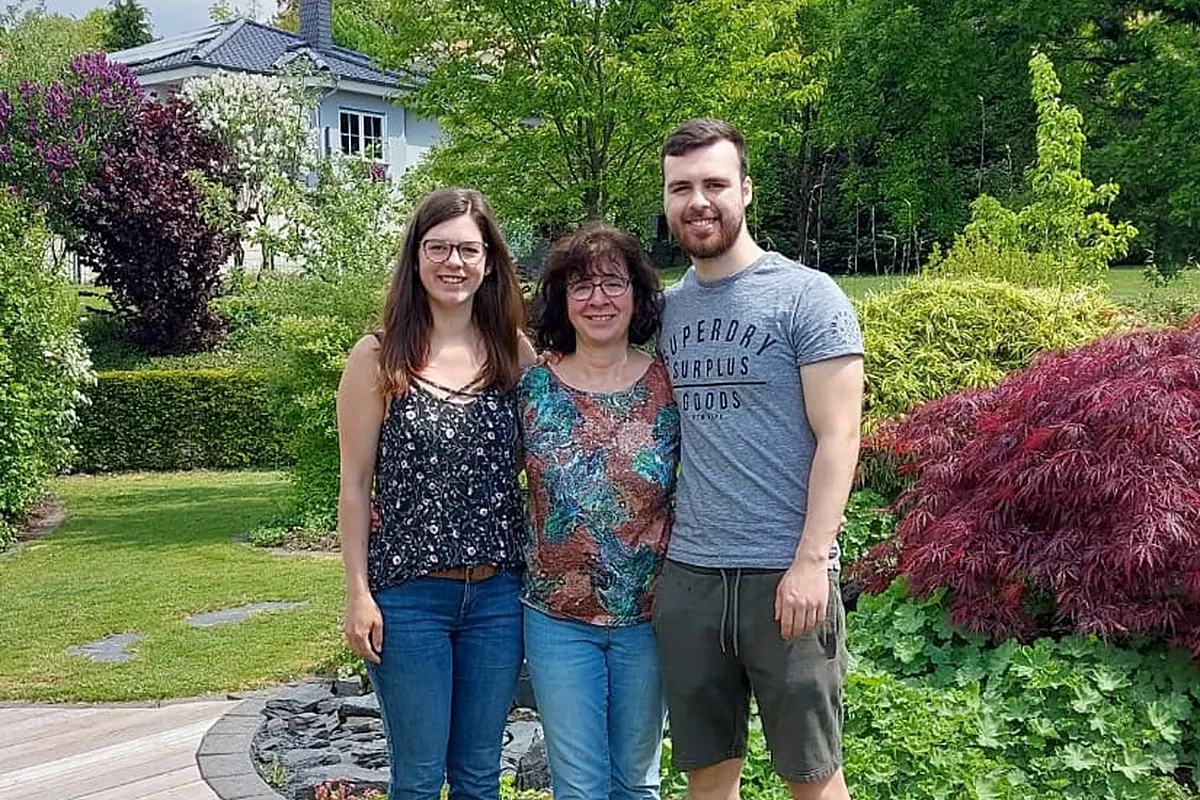
Susanne, Carmen and David Hahn rent out the three holiday homes on the Sonnenterrasse in Rieden and have known the Eifel for more than ten years.